
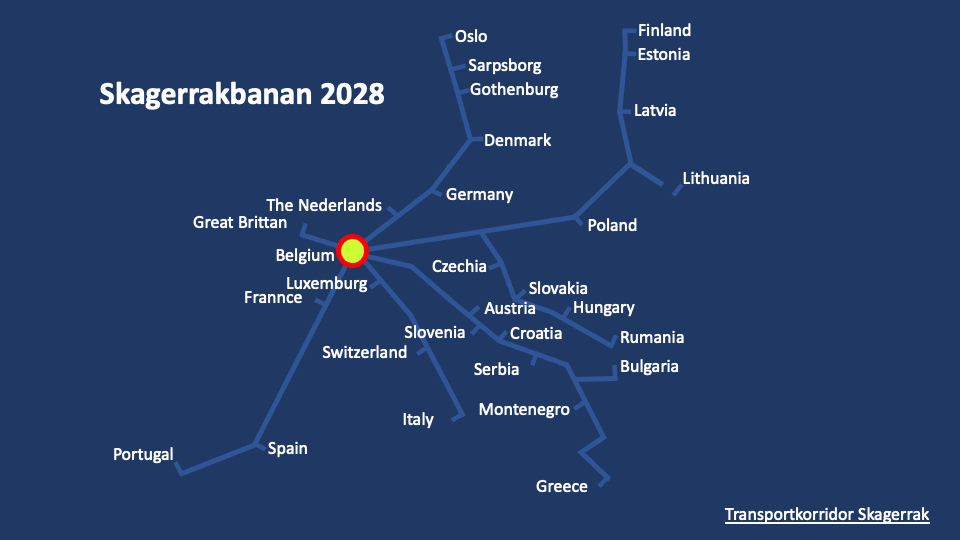
A new high speed railway line crossing the border between Norway and Sweden can be realized much faster than expected. 2028 is the target. The project is driven by a consortium of local governments in Sweden and Norway. The acummulated investment cost by 2028 is estimated to 10 bill. Euro.
Facts about the Skagerrak Railway
Background:
The Skagerrak Railway may be considered as a spin off from the TENTacle project 2016-2019, which was initiated by the Innovation Circle Network and the Blekinge region. It was a BSR Interreg funded flagship project. The pilot named Central Scandinavian Borderland was managed by the Østfold-Värmland Border Council in cooperation with Transnorden Sweden and the think tank TGB2025. During this project there was formulated a vision about the creation of a Nordic high speed railway network. Several studies were carried out. Among those a study about a possible railway between Oslo-Gothenburg-Copenhagen-Hamburg. The study was executed by Tüv-Sud. Based on these studies and also inputs and inspiration from other international high speed projects a group of muncipalities located in Bohuslän region in Sweden took a bold initiative and created the Transport Corridor Skagerrak. Uddevalla city is in charge of the coordination. 4 Norwegian local governments have recently stepped into the dialogue and are now considering to enter the consortium. It is fare to mention that the initiative would probably not have happened if there were more actions and concrete plans for the cross border railways already in place. The national transportation plans and state budgets have many bits and pieces to take care of. There hasn´t been a high priority of cross border railway structures in Scandinavia by the state governments. In some repsect this muncipal initiative is the bottom up answer to the void. The Nordic Council and the cross border councils have for several years advocated a more proactive common Nordic transport strategy, but without any visible results.
Technology:
Shift to rail is a highly prioritized EU policy. However, the old railway system in Scandinavia is not rigged for a major shift. It is quite slow, lack of capacity, big needs for maintenance and for new investments in order to become a real alternative to private cars, lorries, busses and airplanes.
A new flawless high speed railway between the Nordic urban nodes is needed, which can compete with the vast number of flights. Especially in Norway, Finland and Sweden there are more flights per capita than in any other European countries, even at short distances. Some of the heaviest passengers routes in Europe are in Norway, such as between Trondheim and Oslo with 2 mill. pass/year.
The Skagerrak high speed line is expected to connect to Oslo at Ski town and to Gothenburg at Surte. This means that the brand new railway will be about 250 km. This is the first leg in a high speed connection between Oslo and Hamburg, which will take advantage of other investments coming up, such as the Fehmarn Belt fixed link, in 2029. This corridor is also named the STRING or the "8 million city".
The high speed line will be constructed at viaducts for the most part and of course some tunnels are needed. These landbridges are favourable for many reasons, such as investment costs/km, construction time, agriculture, heritage environment, wildlife, other transportation etc. The horisontal and vertical geometry is also more easy to elaborate in order to fit to the required speed and demanded travel time, which is 1 hour at the direct service, and 1: 30 for service with multiple stops.
more info will follow....
More from the network

30 August 2026
Welcome to Edinburgh!
ICN 2026 - 10-11 November
Planning Aid Scotland will host the Innovation Circle Network gathering 2026. The program will focus on various projects and cooperation, with EU fund…
Read more
12 August 2026
ICN 2026 - Edinburgh
Get ready for the ICN 2026, 10-11 November in Edinburgh. More info will follow soon..
Read more
19 August 2025
World cafe in Bialystok
ICN annual meeting in cooperation with FCIS 15 years anniversary
22-24 October there will be an event in Bialystok, focusing on social innovations and especially in Poland, an exploring the FCIS strategy 2030. FCIS…
Read more